

Understanding ADHD Beyond Hyperactivity
Understanding ADHD Beyond Hyperactivity
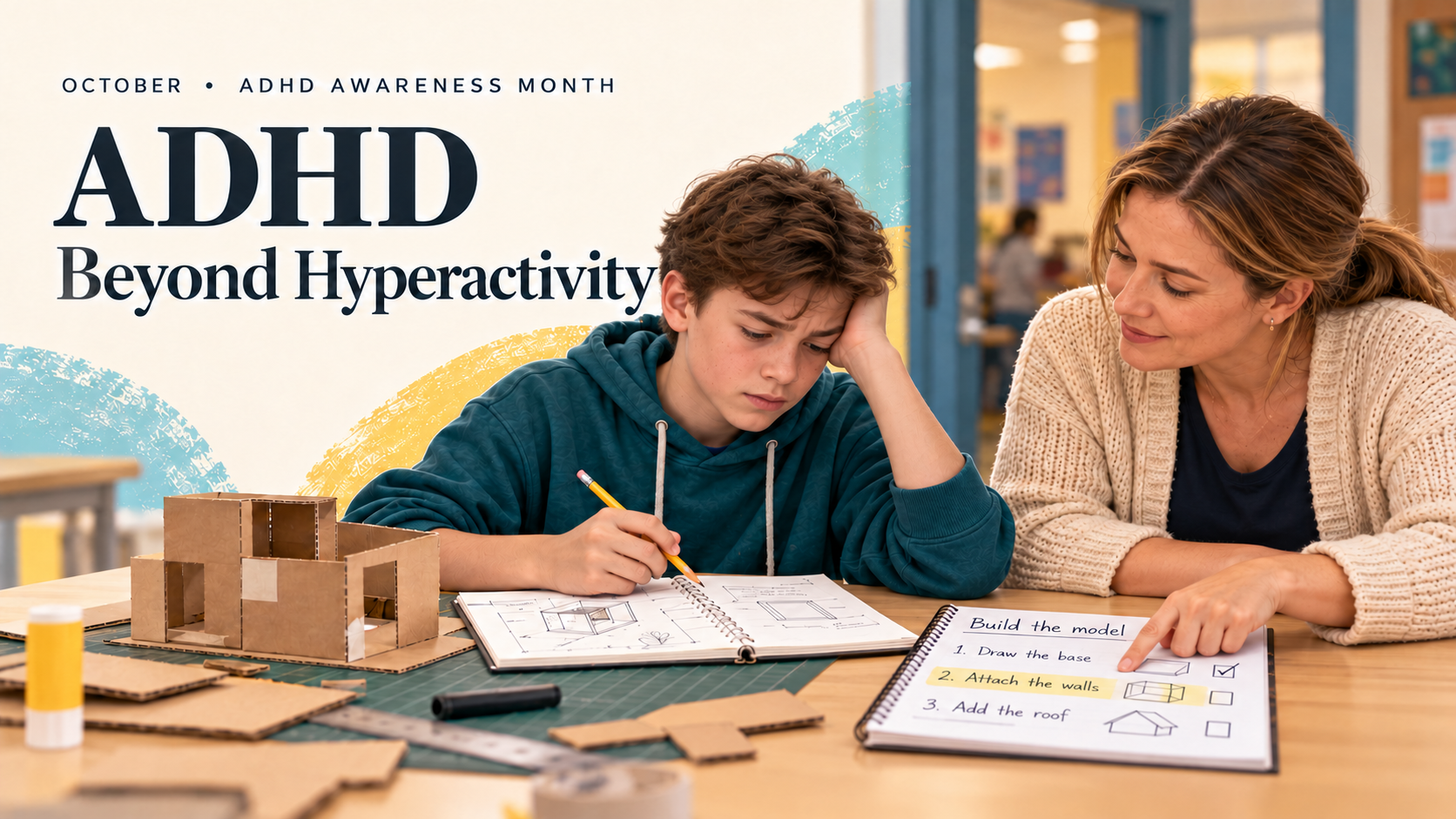
A young person interrupts again. Another forgets an instruction moments after hearing it. A third sits quietly through an activity, then cannot explain what they were supposed to do.
Adults may see disrespect, carelessness, or a lack of effort. In reality, what they may actually be seeing a young person struggling with ADHD.
October is ADHD Awareness Month, an opportunity for youth care workers, teachers, coaches, and other caring adults to reconsider how we interpret behavior. According to CDC, an estimated 7 million U.S. children ages 3–17, or 11.7%, had a current ADHD diagnosis in 2024, based on a national parent survey. Understanding ADHD belongs in everyday youth work. [1, 2]
The symptoms we may overlook
Attention-deficit/hyperactivity disorder is a developmental disorder that can interfere with attention, impulse control, and daily functioning. It has three presentations: predominantly inattentive, predominantly hyperactive-impulsive, and combined. A young person does not have to be visibly hyperactive to have ADHD. [3, 4]
Inattention can look like frequently losing belongings, missing details, struggling to organize or finish tasks, or forgetting routines. Hyperactivity and impulsivity can look like fidgeting, excessive talking, interrupting, or difficulty waiting. Presentations can change over time. [3]
ADHD can also involve difficulties with executive functioning, the mental skills involved in planning, organizing, and managing tasks. Knowing what to do and reliably carrying out the steps can be different challenges. A young person may understand an assignment but struggle to organize the materials and time needed to complete it. [4]
Why try harder can miss the problem
The American Academy of Pediatrics explains that what looks like laziness or low motivation can reflect genuine difficulty functioning. It also cautions that being able to focus on a highly engaging activity, such as a video game, does not rule out ADHD. Sustaining attention during a lengthy assignment can place very different demands on a young person. [5]
That matters when adults say, “You can focus when you want to.” Success in one setting does not tell us what support a young person needs in another.
Emotional regulation can be another area of difficulty. Intense frustration or outbursts can occur with ADHD, but they are not unique to it and do not establish a diagnosis. Similar outward behavior can have different underlying causes and require different responses. [6]
We still need to address hurtful words, unsafe actions, and their impact. Understanding the difficulty gives us a better starting point for helping a young person practice a different response.
Capability and support belong together
ADHD occurs across a range of intellectual abilities, including among young people with high IQs. Strong academic performance or advanced abilities do not rule it out. A population-based study found that children with ADHD and high IQs could still experience significant challenges associated with the condition. [7]
Young people deserve opportunities to lead, learn, compete, and contribute, alongside support for the areas where they struggle. Avoid assuming either that a diagnosis limits their potential or that demonstrated ability makes support unnecessary.
Set meaningful, attainable expectations based on the individual. The goal may remain participation in a group activity, while the route includes a movement break, a visual reminder, or help getting started. Adjusting that route can help a young person demonstrate what they know and build greater independence.
What adults can do differently
CDC identifies behavioral classroom management and organizational training as approaches shown to help students with ADHD. It also describes supports such as clear expectations, immediate positive feedback, movement breaks, and fewer distractions. Individual accommodations should be monitored, because evidence for specific accommodations varies. [8]
Here are practical ways to apply those principles in daily interactions with youth:
- Make the next step clear. Instead of “Get ready,” try “Put your notebook in your bag.” Check understanding before adding another direction.
- Make routines visible. Use a short checklist or posted schedule so remembering every step does not depend on verbal reminders alone.
- Plan opportunities to move. Consider a brief movement break or an active role during an activity, based on the young person’s needs.
- Give specific, timely feedback. “You waited until she finished speaking” tells a young person exactly what worked.
- Ask and observe. Invite the young person to identify what helps. Coordinate with caregivers and relevant professionals, and adjust supports according to what improves participation.
These examples are starting points to individualize, rather than a single formula for every youth with ADHD. Everyday support should work alongside appropriate treatment, which may include behavior therapy and medication depending on age and individual needs. [9]
A different starting question
No single behavior tells us that a young person has ADHD. Symptoms must be persistent, impair functioning, and occur in more than one setting. Sleep problems, anxiety, depression, and other conditions can produce similar symptoms, so diagnosis requires a qualified healthcare professional. [4]
Our role as caring adults is to notice patterns, listen, and respond thoughtfully. Before deciding that a young person simply will not meet an expectation, ask: “What might be making this difficult, and what support would help?”
That question leaves room for learning, accountability, and growth. It also communicates something every young person deserves to hear: We see your capability, and we are willing to help you use it.
Sources
1. CDC. ADHD Partner Toolkit. October awareness observance.
https://www.cdc.gov/adhd/php/partner-toolkit/index.html
2. CDC. Data on ADHD in Children. 2024 current diagnosis estimate from a national parent survey.
https://www.cdc.gov/adhd/data/index.html
3. CDC. Symptoms of ADHD.
https://www.cdc.gov/adhd/signs-symptoms/index.html
4. National Institute of Mental Health. Attention-Deficit/Hyperactivity Disorder: What You Need to Know.
https://www.nimh.nih.gov/health/publications/attention-deficit-hyperactivity-disorder-what-you-need-to-know
5. American Academy of Pediatrics. 8 ADHD Myths & Misconceptions.
https://www.healthychildren.org/English/health-issues/conditions/adhd/Pages/Myths-and-Misconceptions.aspx
6. American Academy of Child and Adolescent Psychiatry. Outbursts, Irritability & Emotional Dysregulation Resource Center.
https://www.aacap.org/aaCaP/Families_and_Youth/Resource_Centers/Emotional_Dysregulation/Home.aspx
7. Katusic et al. Attention-deficit hyperactivity disorder in children with high intelligence quotient: results from a population-based study. Journal of Developmental & Behavioral Pediatrics (2011).
https://pubmed.ncbi.nlm.nih.gov/21200330/
8. CDC. ADHD in the Classroom.
https://www.cdc.gov/adhd/treatment/classroom.html
9. CDC. Treatment of ADHD.
https://www.cdc.gov/adhd/treatment/index.html